Can Beginners Actually Recomp? The Science of Newbie Gains and When to Bulk or Cut
By Mofilo Team
Published 13 min read
Key Takeaways
- New lifters can build muscle and lose fat at the same time. The stimulus of a new training program forces adaptation even without a caloric surplus.
- Starting body fat levels dictate the most effective nutritional path. Those carrying more body fat should eat in a slight deficit, while very lean beginners need more calories to grow.
- Protein intake determines whether a deficit burns fat or sacrifices lean tissue. Consuming a high amount of daily protein protects muscle better than just cutting calories alone.
- The beginner adaptation window eventually closes as the body gets used to the stress. Once strength plateaus and visual changes stop, lifters have to transition to a dedicated bulk or cut.
You decide to start lifting weights, and you immediately hit the most common roadblock. Do you eat to build muscle, or do you eat to lose fat?
The internet usually forces a choice. You are told to bulk, which means accepting fat gain for the sake of muscle. Or you are told to cut, which means shrinking down but risking a skinny fat physique. The conflicting advice leaves most people paralyzed, constantly switching between eating less and eating more week by week.
For someone who has been lifting for three years, that binary choice is mostly accurate. But for a complete beginner, the rules operate differently. A new lifter possesses a temporary physiological advantage that allows them to do both simultaneously.
This window is often referred to as newbie gains. It is a period where your muscle tissue is so sensitive to the novel stress of resistance training that it prioritizes growth almost entirely.
The process is not magic. It relies on specific biological mechanisms that only activate when the environment is right. If you try to stretch a body recomposition indefinitely without managing your nutrition, you will eventually stall. The goal is to maximize this beginner window while it remains open, recognize the signs that it is closing, and know exactly when to shift your strategy.
The Neurological Phase of Early Lifting
Many beginners see their strength double in the first month and assume they are putting on pounds of muscle tissue. They watch the weight on the bar climb steadily every single session. In reality, the scale at home might not budge, and their physical measurements might look exactly the same as day one.
Your initial progress in the gym is largely about coordination. The brain is learning how to fire motor units efficiently and stabilize a heavy barbell. You are essentially teaching your nervous system how to execute a completely foreign movement pattern.
During these early weeks, the adaptations are primarily neural, with actual structural changes to the muscle tissue lagging slightly behind (Maffiuletti et al., European Journal of Applied Physiology 2016).
This is why you feel stronger before you look stronger. You are simply removing the neurological brakes that prevent an untrained person from recruiting all their available muscle fibers at once. The body is becoming more efficient with the tissue it already has.
Once the nervous system adapts to the basic movement patterns, true tissue growth begins. And it happens faster now than it ever will again in your training career.
Untrained individuals experience a significantly higher rate of muscle growth compared to those who have been lifting for years (Morton et al., British Journal of Sports Medicine 2017).
The stimulus of lifting weights is completely new. Your body has no baseline defense against the tension you are applying to the muscles. It has no choice but to lay down new structural tissue to handle the unexpected load.
This rapid growth rate is what makes a beginner recomposition possible. The training stimulus is so loud that it overrides the usual requirement for a calorie surplus. But capitalizing on this accelerated phase requires the right starting conditions, and not every beginner starts from the same place.
Why Body Fat Dictates Your Starting Point
Recomposition is not a blanket guarantee for anyone who touches a dumbbell. Your starting body composition plays a massive role in whether you can successfully build muscle while losing fat.
Building muscle is an energy-intensive process. It costs calories to synthesize new tissue. When you are in a calorie deficit, you are deliberately underfeeding your body. The body needs to find fuel somewhere to fund the expensive process of adaptation.
Stored body fat is essentially banked energy. Individuals with higher initial body fat percentages have an easier time building muscle in a deficit because they have abundant endogenous energy available to make up the difference (Aragon et al., Journal of the International Society of Sports Nutrition 2017).
If you are starting out with a higher body fat percentage, attempting a dedicated bulk is usually a mistake. You do not need the extra dietary calories of a surplus to fund muscle growth. Your body can just pull from its existing fat reserves to cover the energetic cost of building your chest, back, and legs.
For these individuals, eating in a slight deficit provides the best of both worlds. The scale weight might drop slowly, or it might stay completely flat, but their waistline shrinks while their shoulders get wider.
Conversely, if you are a very lean beginner, the recomposition math changes entirely.
A lean body has less stored energy to draw from safely. When a very lean person eats in a deficit, the body is much more reluctant to mobilize fat for energy, and it is certainly not going to waste precious calories building new muscle tissue.
For a lean novice, eating at maintenance or in a slight surplus is usually the better path. If you try to force a recomposition by eating less, you risk spinning your wheels. You will generate plenty of fatigue in the gym, but you will leave potential growth on the table because you simply lack the raw energy required to recover.
The practical takeaway is straightforward. If you have noticeable fat to lose, your goal is a slight calorie deficit. If you are already quite lean and want to get bigger, you need to eat enough to grow. In both scenarios, the novelty of the beginner training phase will drive the results, provided you do not get in your own way.

Proof the scale refuses to show you.
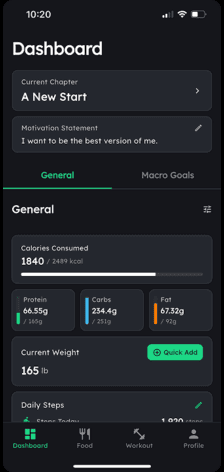
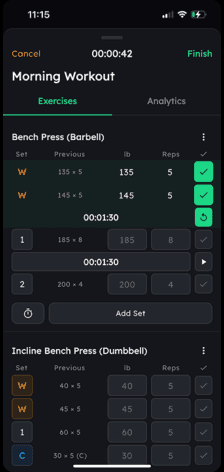
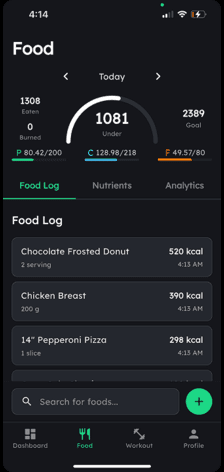
You are lifting heavier, but the scale sits completely flat. Mofilo tracks strength charts and body measurements so the work shows.
No commitment · Cancel anytime
The Calorie Deficit Limit
Even if you have the body fat to support a recomposition, the size of your calorie deficit matters immensely. A deficit that is too aggressive will shut down the process entirely, regardless of how new you are to lifting.
Muscle is metabolically expensive to build and maintain. When food intake drops too low, the body prioritizes essential survival functions over adding discretionary tissue like biceps.
Severe caloric restriction reliably impairs the body's ability to synthesize new muscle tissue, even in the presence of a strong training stimulus (Hector and Phillips, International Journal of Sport Nutrition and Exercise Metabolism 2017).
This is the trap of the crash diet. A beginner will start lifting, get highly motivated by their early progress, and drop their calories drastically hoping for rapid visual results. They might cut their intake down to twelve hundred calories a day, thinking more restriction equals faster fat loss.
They lose weight, but they also lose the specific physiological environment needed for newbie gains. The body registers the severe energy shortage and halts tissue repair.
The result is a smaller version of their starting physique. They end up lighter on the scale, but they do not look leaner or more muscular. They just look depleted.
A moderate deficit is usually the sweet spot for a recomposition. Cutting roughly three hundred to five hundred calories below your maintenance level is enough to coax the body into burning stored fat.
At this moderate level of restriction, the body does not panic. It recognizes a slight energy shortfall, taps into fat stores to cover it, and still allows the muscle building process to continue unimpeded.
Keep the deficit reasonable. Let the training do the heavy lifting for your body composition, and use the diet simply to manage the energy balance. Speeding up the weight loss usually means sacrificing the muscle gain.
The Protein Requirement for Recomposition
Calories dictate the direction of your overall weight. Protein dictates what that weight is actually made of.
If you are asking your body to build muscle while simultaneously losing fat, you are demanding an incredibly complex biological balancing act. You are asking for tissue construction in an environment of energy restriction.
The only way to support this process is by keeping dietary protein high. Without enough raw materials, the muscle simply cannot repair itself after a heavy workout.
Research consistently shows that maintaining a high protein intake is required to successfully achieve body recomposition while eating in a caloric deficit (Kerksick et al., Journal of the International Society of Sports Nutrition 2018).
This is not just a marginal benefit. It is a fundamental requirement for the process to work.
Most beginners undereat protein. They focus entirely on cutting out junk food or lowering their total food volume, without paying attention to the macronutrient breakdown of what remains. They might eat plenty of vegetables and whole grains, but they fall drastically short on the building blocks needed for recovery.
Aiming for roughly 0.7 to 1 gram of protein per pound of target body weight provides a solid foundation. This ensures the bloodstream has a steady supply of amino acids available when the muscle tissue signals for repair.
When protein is adequate and the training stimulus is present, clear evidence demonstrates that complete beginners can successfully build muscle and lose fat concurrently (Bridge et al., Frontiers in Nutrition 2019).
It takes discipline to plan protein around a moderate deficit. You have to prioritize lean meats, dairy, or quality plant sources over casual snacking. But it is the mechanism that makes a recomposition possible.
Without high protein, a calorie deficit just makes you smaller. With high protein, the deficit burns fat while the training builds the frame.
When the Beginner Advantage Ends
No physiological advantage lasts forever. As you gain experience, the body becomes highly accustomed to the stress of lifting weights. The novelty wears off, and the biological urgency to adapt fades with it.
The newbie gains window does not slam shut overnight. It gradually tapers off over a period of months.
For most people, the most dramatic period of accelerated progress begins to attenuate after the first several months of consistent, progressive training (Pellegrom and Filho, Women in Sport & Physical Activity Journal 2025).
The fundamental reason is biological efficiency. The muscle tissue has adapted to the load. It is larger, stronger, and more resilient than it was on day one. A workout that used to leave you sore for three days now feels like a standard warm-up.
As training age increases, the initial spike in muscle protein synthesis that follows a workout becomes blunted and much shorter in duration (Brook et al., The FASEB Journal 2015).
Your body is no longer shocked by the barbell. It requires a more specific, targeted approach to force further adaptation. The same effort that used to build muscle in a deficit will now only maintain what you already have.
This is the exact moment when trying to recomp becomes a waste of time. When the beginner advantage fades, eating at maintenance usually results in stagnation. You sit in the middle ground, neither gaining noticeable muscle nor losing noticeable fat.
You will notice the shift. Your strength stops climbing every week. Your body weight stabilizes. The mirror stops changing month over month.
At this point, you have to choose a direction. If you want more muscle, you need a dedicated calorie surplus to fund the increasingly difficult process of growth. If you want to reveal the muscle you built, you need a dedicated deficit.
The rules of the game change. The middle ground no longer serves you, and you transition from a beginner to an intermediate lifter.
Transition before you start spinning your wheels.
When strength stalls and measurements flatline, the recomp is over. Close the beginner chapter and open your first dedicated bulk.
No commitment · Cancel anytime
Frequently Asked Questions
How long do newbie gains typically last?
Most lifters experience the most rapid phase of growth during their first six to twelve months of consistent training. After that first year, progress slows down to a more normal, gradual rate. The exact timeline depends on how well you recover, how consistently you train, and your starting point. If your programming is poor, you might stretch that window out longer simply because you never fully capitalized on it initially.
Can I still make newbie gains if I am not a complete beginner?
If you have been lifting on and off for years but never followed a structured, progressive program, you might still have a window of rapid adaptation left. Your body responds to new, consistent tension. Simply showing up to the gym and going through the motions does not exhaust your beginner gains if you were never pushing close to failure or adding weight to the bar.
What are the signs that my newbie gains are slowing down?
The most obvious sign is a plateau in your strength. When you are a beginner, you can often add weight to the bar every single week. Once that stops happening for several weeks in a row, and your body weight remains completely unchanged, your initial adaptation phase is likely ending. You will also notice that visual changes in the mirror become much less frequent.
Do I have to track calories to successfully recomp?
You do not necessarily have to track every single calorie, but you do need to control your portion sizes and ensure your protein intake is high. Because a recomposition requires a relatively precise balance, eating just enough to fuel workouts but slightly less than you burn, tracking provides the clearest data to make adjustments. Without tracking, most people accidentally eat at maintenance and just stay the same weight.
Is it possible to lose newbie gains if I stop working out?
If you stop training completely, your body will eventually downsize the muscle tissue because it is no longer needed for daily life. However, muscle memory is a real phenomenon. The neurological pathways remain, and the cellular structures of the muscle are altered long-term. If you return to lifting after a long break, regaining that lost muscle happens much faster than building it the very first time.
Conclusion
The beginner phase is the most forgiving period in your training lifecycle. It is the one time when the normal rules of energy balance bend slightly in your favor, allowing you to drop body fat while adding new tissue simultaneously.
But a recomposition still requires deliberate execution. It is not an excuse to eat poorly or train without a plan. You need a moderate calorie target based on your starting body fat, a high daily protein intake, and a workout program that actually demands adaptation from your muscles.
Eventually, the rapid progress will slow down. Your strength will plateau, and the visual changes will require more specific nutritional phases. When that day comes, you will transition to a dedicated bulk or cut. Until then, take advantage of the window you have and build the foundation.
All content and media on Mofilo is created and published for informational purposes only. It is not intended to be a substitute for professional medical advice, diagnosis, or treatment. Always seek the advice of your physician or other qualified health provider with any questions you may have regarding a medical condition, including but not limited to eating disorders, nutritional deficiencies, injuries, or any other health concerns. If you think you may have a medical emergency or are experiencing symptoms of any health condition, call your doctor or emergency services immediately.
Read more blogs
How to Handle Social Pressure When You Start Eating Healthy
What You'll Learn in 10 Min
- •Why your new diet makes old friends act defensive
- •Which 2 simple responses stop direct food pushback
- •How occasional compromise beats rigid macro tracking
A Structured Ramp-Up Protocol When You Have No Motivation to Workout After Vacation
What You'll Learn in 9 Min
- •Why lost drive is a metabolic shift, not willpower
- •How to drop total sets to prevent crippling soreness
- •Which low-intensity moves restore your nervous system
How to Maintain Muscle During a Two-Week Vacation From the Gym
What You'll Learn in 12 Min
- •Why early vacation size loss is just water and carbs
- •How restricting calories on a break speeds muscle loss
- •Which protein timing mistake costs you lean mass daily