How to Build Muscle and Lose Fat When You Work 12-Hour Shifts
By Mofilo Team
Published 11 min read
Key Takeaways
- Muscle growth requires a reliable recovery environment that a rotating schedule naturally disrupts. You have to consolidate your training volume onto your off days instead of fighting post-shift fatigue.
- Nutrition on shift work divides into daylight hours and biological night. Eating your heaviest meals during the day and keeping night-shift food light helps manage the metabolic friction of staying awake.
- Sleep quality matters more than workout frequency for preserving lean mass. A three-day lifting split with adequate rest produces better results than dragging yourself to the gym sleep-deprived five days a week.
- Base your calorie and protein targets on a weekly average rather than a strict daily clock. Shift transitions make daily tracking chaotic, but looking at a rolling seven-day total keeps you on target.
You clock out at 7:15 AM after a brutal rotation on the floor. Your feet throb. Your head aches from the fluorescent lights and the constant alarms.
Standard fitness advice says you should go straight to the squat rack or head home to eat a perfectly portioned meal of chicken and rice. You choose the couch and whatever food is closest instead.
Then the guilt sets in. You feel like you are failing at fitness because you cannot sustain the daily routines you see online.
The problem is not your discipline. The problem is trying to map a schedule built for a standard office worker onto a life that operates in twelve-hour clinical or industrial blocks. Your circadian rhythm is entirely different.
Your appetite signals arrive at the wrong times. Your physical fatigue accumulates in a way that makes standard high-frequency training programs nearly impossible to recover from.
Most fitness frameworks assume you sleep eight unbroken hours every night in the dark. They assume you have evenings free to cook and weekends off to rest. When those variables disappear, the rules of training and eating have to change. You need a framework that fits the life you actually live.
Why Your Post-Shift Workouts Are Failing
Standard workout plans usually demand four to six days in the gym. They expect you to push close to failure and recover overnight. That equation breaks down when you spend twelve hours on your feet managing patients, operating heavy machinery, or responding to calls.
Your central nervous system takes a beating during a long shift. By the time you hand over your duties and walk to your car, your capacity to generate force is severely compromised. Walking fifteen thousand steps on concrete is wear and tear, not a muscle-building stimulus.
You might feel mentally wired from caffeine, but your physical output is blunted. Mental and physical exhaustion directly degrades resistance training performance and limits the amount of quality work you can actually complete (Sweeney et al., Journal of Occupational and Environmental Medicine 2025).
Trying to force heavy compound lifts in this state usually leads to garbage volume. You are accumulating joint stress and systemic fatigue without actually stimulating muscle growth. The tension you place on the muscle is too low to force an adaptation, but the cost to your joints is high.
Many shift workers fall into the trap of thinking any workout is better than no workout. This is only true if you can recover from it. Hitting the gym after a twelve-hour shift often digs a recovery hole that ruins your days off.
The fix is accepting that work days are for work.
If you try to do everything every day, you will likely fail at all of it. Your primary goal on a shift day is survival, hydration, and getting home safely.
The Circadian Trap
Your body runs on an internal clock. Digestion, hormone release, and core body temperature all follow a rhythm synced to daylight.
When you work nights or rotating shifts, you force your biology to operate out of phase. This is not just a matter of feeling tired. Staying awake and eating when your body expects to be asleep fundamentally changes how you process nutrients.
Night shift work and the resulting circadian misalignment directly impair insulin sensitivity and overall metabolic health.
Your cells become less efficient at pulling glucose out of your bloodstream during the night. A meal that your body handles perfectly at noon might cause a prolonged blood sugar spike at three in the morning. Your pancreas is releasing less insulin, and your muscles are less receptive to it.
This explains the sluggish, bloated feeling that hits around 4 AM after a heavy mid-shift meal. Your digestive tract is essentially powered down for the night, but you are forcing it to work.
You cannot change the fact that you have to be awake. You can change how you feed yourself during those hours to minimize the metabolic friction. Aligning your food choices with your compromised digestion is a major step toward better body composition.
What to Eat During a Night Rotation
The most common nutritional mistake on a night shift is treating midnight like noon.
Because you are awake and working hard, you assume you need a standard dinner. People order takeout or bring large containers of dense food to the break room. Forcing your digestive system to process heavy proteins and large amounts of fat during the biological night leads to severe metabolic strain (Robinson et al., Nutrients 2025).
Your body is not built to digest a steak at three in the morning.
The better approach is to graze on easily digestible foods while you are on the clock. Keep your shift meals light. Think whey protein shakes, Greek yogurt, small portions of fruit, or clear soups. These foods provide amino acids and quick energy without requiring massive digestive effort.
Save your largest, most calorie-dense meals for your waking daylight hours. This might mean eating a large meal right before your shift starts in the evening, or immediately after you wake up in the late afternoon.
Hydration plays a massive role here as well. Shift workers often mistake dehydration for hunger in the middle of the night. Drink water consistently throughout the shift, and cut off caffeine at least six hours before you plan to sleep. Chugging coffee at 2 AM ruins the daytime sleep you desperately need at 8 AM.
By shifting your heavy calories to the daylight hours, you work with your circadian rhythm instead of against it.

A target that survives the night shift.
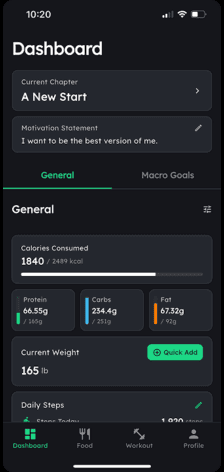
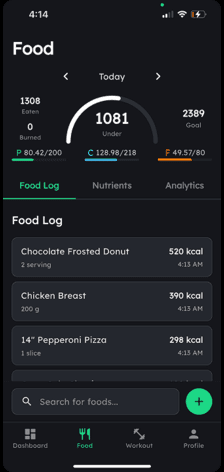
A daily tracking window fails when you work rotations. Mofilo anchors your targets to the week so transition days balance out.
No commitment · Cancel anytime
Structuring Your Training Around Your Off Days
If you work three or four twelve-hour shifts a week, your off days are your actual training window.
Stack your workouts on the days you do not work. A three-day full-body split or an upper-lower rotation fits perfectly into a nurse or first responder schedule. You train when you are rested, fed, and capable of real effort.
You train when you are rested.
On your work days, your only physical goal is basic movement. If you feel stiff and want to do something to stay loose, break it down into tiny chunks. Brief bouts of movement or exercise snacking are highly effective for maintaining baseline fitness when you have zero free time (Zamora et al., American Journal of Health Promotion 2025).
Five minutes of bodyweight squats in the break room or taking the stairs instead of the elevator counts as movement. It keeps blood flowing without adding systemic fatigue.
Do not attempt a structured weight training session on a day you are already standing for twelve hours. Save your limited energy for the days you can actually recover from the stress.
Protecting Muscle Mass When Sleep is Broken
Shift workers operate in a constant state of sleep debt. You piece together six hours here, four hours there, and try to catch up on your days off.
This fractured sleep schedule blunts your body's ability to repair tissue. Chronic partial sleep deprivation actively suppresses muscle protein synthesis and alters the hormones responsible for recovery.
You are breaking muscle down in the gym, but your body struggles to rebuild it while you sleep in a bright room during the day.
To offset this, you need to be meticulous with your protein intake. Because your sleep is compromised, your nutrition has to carry more of the recovery burden. Aim for a high daily protein target and distribute it evenly across whatever hours you happen to be awake.
You cannot always control your sleep environment. The dog will bark, the delivery driver will knock, and the sun will shine. You can control your protein intake.
Prioritizing protein ensures your muscles have the raw materials they need, even when the hormonal environment is less than ideal. A slow-digesting protein source like casein or Greek yogurt right before your daytime sleep can help keep amino acids in your bloodstream while you rest.
How to Handle Transition Days
The hardest part of shift work is the day you flip from nights to days, or days to nights.
Your appetite is entirely confused. You might be awake for twenty hours straight, leaving you unsure of how to track your calories. A rigid daily tracking window falls apart during a transition.
The solution is to zoom out. Stop looking at a single day and look at a 48-hour rolling average instead.
If you eat three thousand calories on a long transition day and one thousand calories the next day because you slept for fourteen hours, your average is still two thousand calories. Your body does not reset its metabolic ledger at midnight.
Use transition days for absolute rest. Do not try to squeeze in a workout while you are running on fumes. Eat when you are hungry, prioritize hydration, and get to sleep as soon as your schedule allows.
Do not weigh yourself after a night shift.
The psychological stress of transitions often shows up on the scale. Water retention and elevated cortisol will make your weight spike wildly after a night rotation. Ignore the scale on these days entirely. Wait until you have had two normal nights of sleep before looking at your weight trend.
Stop forcing a standard schedule.
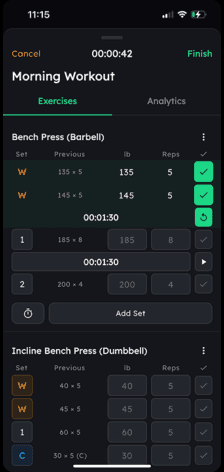
Your shifts rotate. Your tracking should match. Voice log your meals in seconds and let the weekly check-in handle the math.
No commitment · Cancel anytime
Frequently Asked Questions
Is it bad to lift weights right after a 12-hour shift?
Most of the time, yes. You are mentally fatigued, your injury risk is higher, and the quality of your sets will be poor. It is usually better to go home, prioritize sleep, and save your training volume for your off days when you can actually recover.
How do I eat enough protein on rotating night and day shifts?
Rely on convenient, prep-free sources during your shifts. Whey protein, pre-packaged Greek yogurt, and protein bars are much easier to consume on the floor than a full meal of chicken breast. Keep these quick options in your locker or bag so you never miss a protein feeding.
Can I make strength gains working 3-on, 4-off 12-hour shifts?
Yes, absolutely. Three days of focused, progressive lifting on your off days is enough frequency to build significant strength and muscle mass. Many people make better progress training three days a week fully rested than they do training five days a week exhausted.
How do I sleep enough to recover when my schedule keeps changing?
Focus on sleep hygiene over total hours if the schedule is out of your control. Blackout curtains, a cold room, and a white noise machine help maximize the quality of the sleep you do get. Getting five hours of deep, uninterrupted sleep is often better than seven hours of tossing and turning in a bright room.
Should I do cardio on my off days?
If your job keeps you on your feet for twelve hours, you are already getting a massive amount of low-intensity activity. Prioritize resistance training and sleep on your off days. Only add formal cardio if you genuinely enjoy it or if your specific cardiovascular health requires it.
Conclusion
You do not need to mimic the routine of a fitness influencer to see real progress. Your schedule is harder, and your recovery window is smaller. What you do in the gym is part of the picture, not the whole one.
That means your plan needs to be built around reality, not an ideal scenario. Stop trying to squeeze heavy leg days into the narrow gap between a night shift and a nap. Move your lifting to your days off. Keep your mid-shift meals light to respect your circadian rhythm, and manage your protein intake to cover for lost sleep.
Your body adapts to what you consistently give it. Better training and recovery on the days you are actually rested eventually change the outcome. You just have to stop fighting your schedule and start working within it.
All content and media on Mofilo is created and published for informational purposes only. It is not intended to be a substitute for professional medical advice, diagnosis, or treatment. Always seek the advice of your physician or other qualified health provider with any questions you may have regarding a medical condition, including but not limited to eating disorders, nutritional deficiencies, injuries, or any other health concerns. If you think you may have a medical emergency or are experiencing symptoms of any health condition, call your doctor or emergency services immediately.
Read more blogs
Are Standing Desks Worth It for Weight Loss? What the Research Really Shows
What You'll Learn in 11 Min
- •Why standing all day reduces your evening calorie burn
- •How alternating postures stabilizes daily blood sugar
- •Which under-desk upgrade forces a real energy deficit
24-Hour Shift Fueling: What to Eat When You Cannot Plan Your Day
What You'll Learn in 11 Min
- •How pre-shift carbs dictate your early morning energy
- •Why heavy 2 AM meals spike your blood sugar so fast
- •When small caffeine doses beat massive energy drinks
How to Handle Social Pressure When You Start Eating Healthy
What You'll Learn in 10 Min
- •Why your new diet makes old friends act defensive
- •Which 2 simple responses stop direct food pushback
- •How occasional compromise beats rigid macro tracking